Assembly Tool Calibration Requirements: What You Need to Know

Whether weighing apples or tightening a fastener, it’s essential that measuring equipment delivers consistent results. Without this accuracy, there’s no way for a customer to know if they’re getting what they asked for. Although a shortage of apples is mildly inconvenient, an incorrectly tightened fastener could be extremely hazardous.
Calibration ensures that different measuring equipment used in different places agree within an acceptable margin of error. This is best achieved by ensuring traceability back to a “master” standard maintained by a national organization, such as NIST, and by quantifying the amount of uncertainty in the measurement.
The two primary standards related to calibration are 1) ISO 9001, which offers guidance on identifying measurement equipment used in production and developing calibration procedures, and 2) ISO 17025, which specifies how calibration should be performed.
ISO 9001
This standard details the requirements for a Quality Management System (QMS). While initially directed toward manufacturing, today’s businesses operate a QMS either compliant with or based on ISO 9001.

Some industries have used ISO 9001 as a starting point, but have added additional requirements specific to their own processes, markets, or customer expectations. Automotive companies, for example, operate systems meeting the International Automotive Task Force (IATF) IATF 16949 standard, which is an extension of ISO 9001. Similarly, aerospace and defense companies adhere to AS 9100, while medical device manufacturers follow ISO 13485.
ISO 9001 and its related standards have a comprehensive list of requirements for procedures that address every activity affecting product quality and customer satisfaction. Inspection is part of this process, and within inspection are requirements for the calibration of measuring equipment that affects the product.
The requirements, detailed in section 7.1.5 of ISO 9001:2015, require the organization to identify important measuring equipment and then put appropriate controls in place to ensure they provide dependable results. This means setting up a documentation and calibration system, and if measurement traceability is required, there must be linkages back to NIST standards.
ISO 17025
Formally titled, “General requirements for the competence of testing and calibration laboratories,” ISO 17025 dictates processes for carrying out equipment calibration to ensure the labs responsible for calibrating measurement equipment follow the appropriate procedures.
A business that calibrates its own measurement devices may choose to get that lab certified to ISO 17025. If a business contracts calibration work to an external laboratory, that business should only work with an ISO 17025-compliant partner.
ISO 17025 has three main requirements:
- Resource Requirements: This section of the standard outlines requirements related to selecting, training, and supervising personnel, managing the facility and environmental conditions, using, storing, and maintaining equipment used for calibration, as well as establishing metrological traceability.
- Process Requirements: Provides an overview of selecting, verifying, and validating methods, sampling, handling sample calibration items, record-keeping requirements, how to evaluate measurement uncertainty, validating and reporting results, how to handle complaints and nonconforming work, and how to control and store the data.
- Management System Requirements: Outlines two options for management systems, one which applies to laboratories with external quality management systems, and another which applies to laboratories with their own ISO 9001:2015-compliant management systems. The section provides guidance on documenting within the management system, including how to handle corrections when needed, and when and how to conduct internal audits and management reviews.
A lab that is considered compliant with ISO 17025 means that they employ competent staff, have proven that their processes are transparent, and that their documentation and reporting are highly traceable.
When Calibrations Should Be Performed
Calibration frequency is an important topic because performing assembly or inspection with devices that read incorrectly can result in complaints, lawsuits, and even fatalities. Both ISO 9001 and ISO 17025 say a calibration frequency should be established, but they don’t specify exact periods because every situation is different.
- Annual Calibrations: For most businesses, the default frequency is annual, with shorter periods being adopted when considered appropriate.
- Bi-Annual: Shorter, six-month calibration periods may be recommended in high-volume and safety-critical applications.
- Three-Month: In situations where problems could be particularly serious, or where measurement instrument drift is a known problem, three-month calibration periods may be recommended.
- A Tool is Dropped or Damaged: It’s best practice to calibrate a tool when it’s been dropped or after it’s been repaired.
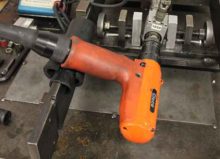
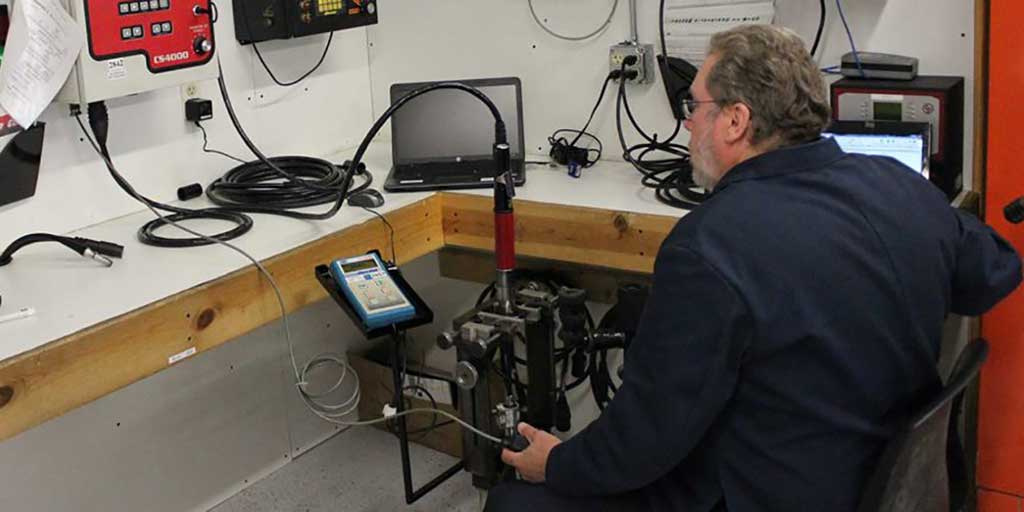
A method of backing up or supporting calibration is through weekly or even daily verification, which is about ensuring measurement equipment is fit for purpose. For example, an inspector could verify that a micrometer is measuring correctly by using it to measure a 1.000″ gauge block. In the case of DC fastening tools, a plant might install torque/angle analyzers that operators can use to check their equipment.
Maintaining Compliance
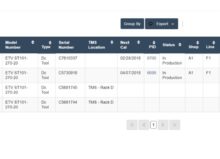
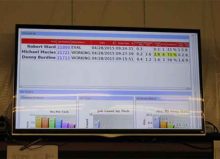
In the calibration sections of ISO 9001 and related standards, there’s an expectation that businesses will put systems in place to ensure all quality-related measurement equipment remains in calibration. To do this, every item is given a unique identification and logged in a database system. Then, before the calibration runs out, it will be flagged, retrieved, and sent for re-calibration.
Some organizations try doing this through Excel, while others use dedicated calibration software. The limitation of both approaches, though, is that they rely on internal staff, who are sometimes operating under limited resources, staying on top of everything. In busy plants, and especially when people are carrying out multiple tasks, there’s always a risk of things going wrong.
The alternative is to contract calibration management.
How Encore Systems Can Help
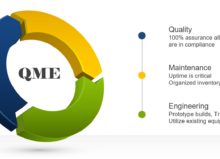
Encore Systems offers a robust tool management program for assembly plants across North America and Mexico. Through this program, you not only get customized tracking software but also dedicated staff, provided by Encore Systems, that help you manage tools, perform inspections and calibrations on schedule, and make repairs as needed.
Reduce unnecessary risks by enrolling in this program. Contact a representative from Encore Systems today to learn more.